

Rethink° December
We took a few days off over Christmas and New Year. Now we are back with money, the persistence of colonial legacies and a fight over inequality.



Okay, let’s start 2024 with a rethinking of money. “So you think that money is the root of all evil? [...] Have you ever asked what is the root of money?” asks the writer Ayn Rand. So let’s get down to the core of money and figure out if money can be good.
(You don’t care about money? Skip this section and jump directly to our article summaries)
Rethinking money
In essence, money is what makes the human species so successful: Mass cooperation. Millions of humans agree on the same rules and trust in the same medium of exchange. Money makes society work on this large scale. And the great thing, the way money works, is no law of nature. It’s a human design and therefore, we can change it.
Why change money?
Isn’t money good already? Well, not really. In a wealthy country like Germany, 1 out of 4 people are stressed when thinking about money. And that is due to the design of money. Money is created by debt, every Euro, Dollar, or Yuan we have in our accounts, is someone’s debt and someone will have to pay interest on them. Where does the interest payment come from? Well, you’ve probably guessed it: new debt. Our money creation therefore has an inherent growth mechanism built in. We see that we need growth, as soon as we enter a recession. In a recession, less money is invested and created, so the whole system starts to tumble and fall.
Secondly, money is anti-gravitational — at least metaphorically speaking. Due to the interest, money always flows towards money and leads to growing inequality. This is because interest is not only what we pay for loans and receive for savings, but also influences our prices when shopping and the cost of rent. In 2007, economic analyst Helmut Creutz showed that interest rates lead to ever greater inequality. He calculated who effectively pays the interest and who receives more money as a result of the interest. The eight groups centiles with the lowest wealth paid more interest than they received. The group with the greatest wealth receives around 90 percent of all interest payments. The group with the second largest assets receives the remaining ten percent. This means that 90 cents of every euro of interest paid went to the same group of people. In 2007, 255 billion euros flowed from poor to rich - solely due to interest payments. Money moves upwards.
What now? Rethink money!
Interest rates create a competition for money. Because there is too little to pay for everything, people compete for the rest of the money. New money is mainly given to those who are better at multiplying their money than others and it is not directly related to social added value. And so the money is often lacking in precisely those areas that are important for society but not particularly competitive.
Hospitals, care facilities and nurseries have to make savings and find it difficult to obtain new loans. After all, they have to earn the interest from their patients or children in their care, and they are not always particularly solvent. The nursing crisis and lack of daycare places show this: There is a lack of money in this area.
So what can be done? Money is a human construct, an agreement. This can be changed at any time. While we can't run to the central bank and immediately change how money works, we can start on a small scale. We can invent money ourselves, at our doorstep.
Civics and regional money
In the Brazilian city of Curitiba, a garbage currency was developed. There was a major waste problem in the city's poorest neighborhoods. Citizens could first exchange their garbage for bus tickets, and later as well for food and learning materials. It wasn't just the neighborhoods that were freed from garbage. The newfound mobility also reduced unemployment and increased average incomes.
There are many other examples that deal with local problems and solutions. In Belgium, there is the Torrekes, which gives committed citizens access to a small allotment garden, in Japan there is the Fureai Kippu, a time-based currency for care, there are Time Dollars in the USA, WIR in Switzerland and in Germany there is already a whole range of regional currencies, such as the Chiemgauer or the Roland in Bremen.
Who knows, maybe there is already a regional currency in your region, or you have a good idea of what it is needed for.
Moving away from debt-based money creation?
In addition to regional currencies, there are also movements that want to make money creation more democratic and move away from debt-based bank money. The Vollgeld Initiative in Switzerland, for example, is calling for money to be created only through the "printing of new money" by the central bank. The Positive Money movement in the UK is also campaigning for money that promotes the common good and is less likely to be exploited for private profit.
Money creation concerns everyone: Currently, a large proportion of money creation profits (seniorage) go to private banks. According to a study, the UK loses between one and three percent of its gross domestic product each year due to private money creation. This would have amounted to between 26 and 78 billion US dollars in 2017. Expenditure on state social benefits amounted to around 48 billion US dollars in that year. That could have been paid for by the seniorage for example.
So let's summarize once again. Money is scarce - not by nature, but because it is designed that way. Moreover, money generally flows upwards, to where there is already money. As a result, it is not only scarce, but also unevenly distributed and lacking in places that can bring great added value to society. Regional currencies can remedy this, as economics professor Bernard Lietaer, among others, emphasizes.
This is a short version of an article written for the Good News Magazine (German) and inspired by the book Rethinking money by Lietaer & Dunne. You can request the full English article via mail.
‘There’s No Other Job’: The Colonial Roots of Philippine Poverty
📰 Teaser: Decades after independence, the Philippines lacks the kind of factory economy that has lifted other Asian nations, tying millions to farm work. In a region defined by upward mobility through manufacturing, the Philippines stands out as a nation still heavily reliant on agriculture — a legacy of outside rule. Nearly 80 years after the country secured independence, the colonial era still shapes the structure of its economy. Because the United States opted not to engage in large-scale redistribution of land, families that collaborated with colonial authorities retain oligarchic control over the soil and dominate the political sphere. Policies engineered to make the country dependent on American factory goods have left the Philippines with a much smaller industrial base than many economies in Asia.
Continue Reading (→ The New York Times; 11 min)
🤔 Max’ two cents: Structural reforms or the lack thereof determine path-dependencies, and are a particularly relevant perspective to view former colonies. The Spanish crown, which rained over the Philippines for around 300 years, and later the United States, which set out to turn the country into a best-practice colony (whatever it should have meant it did not work out), and the Marco´s regime had little interest in creating an equitable economy and reducing poverty. It was simply too tempting to keep power, both political and economic, highly concentrated. This made governing the colony easier and facilitated the exploitative colonial economies around sugar cane, and minerals. As a consequence, millions remain impoverished and malnourished, despite significant advances in the past three decades. Even today, there is little industry to speak of, and the reliance on a service sector (tourism and BPOs) and the remittances (~9% of GDP) by Overseas Filipino Workers (OFWs) make the economy susceptible to economic shocks such as the past financial and economic crises. All the while, elites and their political dynasties still dominate politics and inequality persists at staggering levels. While I am in no position to provide advice what a Philippine government ought to do, the lessons for overseas interventions are clear: perpetuating existing unequal and commonly oppressive power structures is the easy path in the short-run but ultimately cases serious repercussions (civil wars, insurgencies, authoritarianism, …). Similar issues undermined token efforts to create an Afghan democracy (The U.S. and allied forces relied heavily on warlords, who had surprisingly little interest in supporting democratic developments).
Why economists are at war over inequality
📰 Teaser: According to a familiar saying, academic disputes are so vicious precisely because the stakes are so low. But in a scholarly battle over inequality, the stakes are rather higher. Research by a trio of French economists—Thomas Piketty, Emmanuel Saez and Gabriel Zucman—has popularized the notion that American income inequality is soaring. Other economists have built heaps of research upon these findings, while politicians have pledged to undo the trends through higher taxes and spending. To most people, the phrase “inequality is rising” seems self-evidently true.
Others have cast doubt on the trio’s findings, however—notably Gerald Auten of the Treasury Department and David Splinter of the Joint Committee on Taxation, a nonpartisan group in Congress. We first analysed their work in 2019, as part of a cover story. It modifies the French trio’s methodology and comes to a very different conclusion: American post-tax income inequality has hardly risen at all since the 1960s Continue Reading (→ Economist; 4 min)
🤔 Moritz’ two cents: This was my trigger to pick up Piketty’s Book Capital of the 21st Century (more at the book club). The argument presented by Piketty (a.o. that inequality is highest since before the world wars) is presented compelling, so the Economist article hit me hard, as having to question my beliefs again. Luckily, I do not have to lead the argument here, but Zucman - one of Piketty’s co-authors does it for us on X. Zucman points out the following flaws in Auten Splinter:
They assume that untaxed business income was far more equally distributed than the taxed business income, which grew more concentrated over time.
They allocate tax evasion to the poor (not to the rich that make themselves look poor to evade taxes),
They also assume that untaxed capital income is also much more equally distributed than taxed capital income.
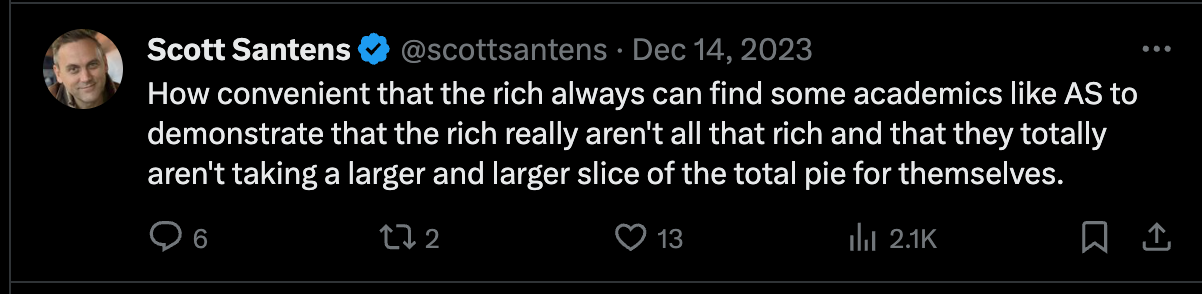
When reading those implicit assumptions out loud as explicit assumptions as phrased by Zucman, this hardly sounds valid. “These assumptions deliver results that are widely inconsistent with evidence on the concentration of wealth” posts Zucman on the thread and one user adds the following:
📚 Rethink° Book Club
Please share with us what you are reading.
Moritz: I am reading Capital of the 21st century by Thomas Piketty. It’s certainly not the easiest book to start the year with, but it’s been looking at me for some time now, so I had to give it a go. I already learned that growth alleviates some persisting forms of inequality but in turn leads to new forms of inequalities, it is not effective in mitigating or reducing inequalities. And in periods of high growth (1950s - 1970s) workers can build wealth from work rather than from capital. In low growth periods, this is significantly harder to accomplish and not on a wide scale. And inequality levels are back to where they were in the early 20th century (before the world wars).
Max: I am travelling in Asia currently to meet with old friends again, so at the moment I am not reading any long-form. Once I am back in Germany, I have some books waiting focusing on impact investing and climate finance.
Send us your recommendations, and we’ll list the highlights: me@mjmey.com
Not yet enough? Here are some evergreens and recent content we came across:
🎧 Outrage and Optimism on climate policy and action by the chair of the Paris Climate Agreement Christiana Figueres, Tom Rivett-Carnac and Paul Dickinson.
🗞️ The ESG on a Sunday newsletter is for everyone who wants to keep up with developments in sustainable finance.
🎥 Water Bear is a non-profit movie platform focused on advancing activism, as a Netflix for impact.
📅 Rethinking is timeless. Read or listen to November issue.
Have you encountered something we might want to read/listen/watch? Please send it to us or leave a comment.
We hope you enjoyed it. Please comment, subscribe, and share.
All the best, and keep rethinking,